Blastproof - Approve outcomes, not commands
A safety gateway for AI agents: every risky write runs on a database copy first, so humans approve what it will actually do, not cryptic commands.
Technologies Used
Blastproof is a safety gateway that lets AI agents take real actions on real systems, without the risk. Every write an agent attempts runs first on a disposable copy of the database, is explained in plain language with exact numbers, is judged by rules and an AI risk judge, and is then auto-approved, blocked, or held for a human, before it is committed exactly as previewed with a full audit trail. Humans stop approving cryptic commands and start approving outcomes.
Key Features
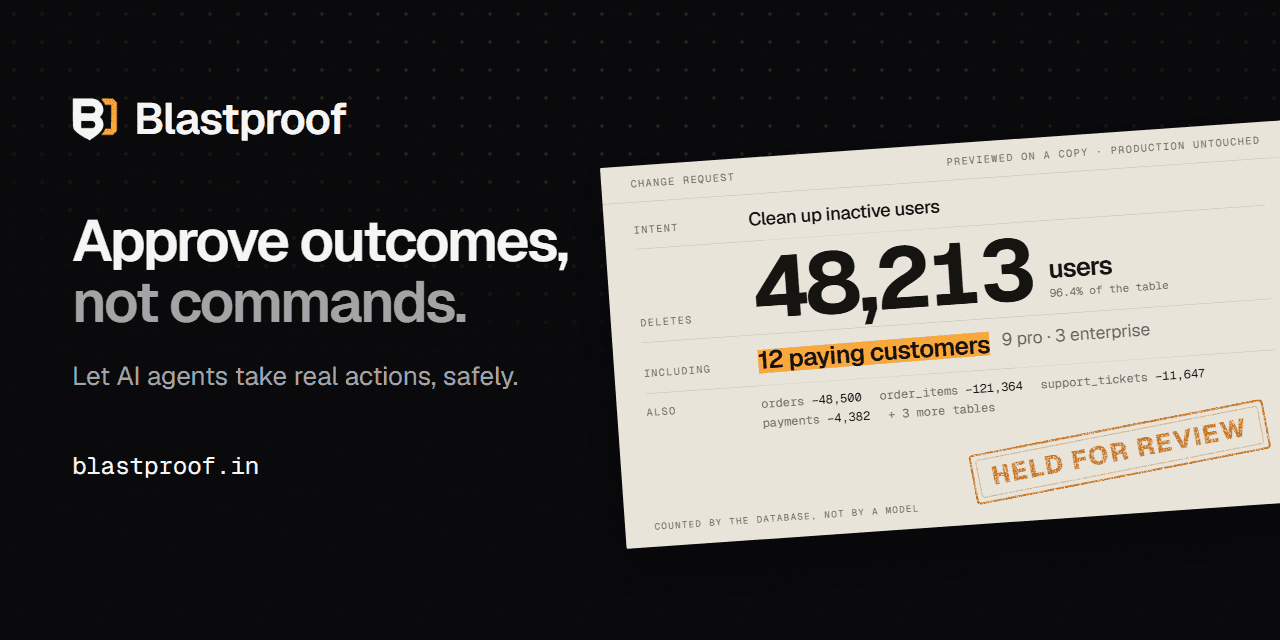
- See the blast radius before it happens: every write runs first on an instant Neon database branch, so a reviewer reads "deletes 48,213 users, including 12 paying customers" instead of raw SQL
- Code counts, the AI explains: every number in an impact report comes from the database, never from a model, and each one is verified before it reaches a human
- Three layers of defense: deterministic policy rules run first, an AI risk judge adds caution in gray areas, and a person has the final say. The judge can only make a decision stricter, never looser
- Works with Claude Code and any MCP agent through an MCP gateway and a PreToolUse hook, with no change to how the agent works
- Credential isolation: company database keys live only in the backend, so there is nothing for an agent to find, leak or misuse
- Commit exactly what was approved: the previewed statement is pinned, checked for drift, and rolled back if the result differs from the approved diff
- Fail-closed by design: any error, timeout or unreadable statement stops the write, and pending approvals survive restarts
- Live review dashboard: review queue, plain-language change requests, searchable history, agents, users, rules and a knowledge base, with every action visible only to its owner
- Proven with evals: 12 of 12 real-world incident replays caught, 51 of 51 dangerous actions blocked or held across 63 labelled scenarios, exact row counts on 37 of 37 previews, and just 9.4 ms of added time on reads at p95
- Production-grade engineering: 2,600+ automated tests, evals that gate every pull request, and a live deployment on Fly.io and Vercel
Frontend Architecture
The dashboard and public landing page are built with Next.js (App Router), React 19 and strict TypeScript, styled with Tailwind CSS and shadcn/ui for a clean, accessible and responsive interface. Server data flows through TanStack Query with near-live polling, so new change requests appear without a refresh, and filters live in the URL so every view can be shared and restored with the Back button. API types are generated straight from the backend's OpenAPI schema, and Zod validates every form. Sign-in runs through a server-side proxy that keeps the session in an httpOnly cookie, so the browser never touches a token. The landing page features an animated architecture diagram and is tuned for a perfect Lighthouse score. Deployed on Vercel.
Backend Architecture
The backend is an async FastAPI service on Python 3.13 that acts as an MCP server, a Claude Code hook API and a REST API in one. Reads take a fast path straight through. Writes enter a LangGraph workflow with a Postgres checkpointer: sqlglot classifies the SQL, a Neon branch runs the preview, a diff engine counts the real changes, and RAG over schema docs and business rules (pgvector with local embeddings) gives the numbers meaning. YAML policy rules decide first; a pluggable AI judge (Claude Sonnet 5.5) can only tighten the verdict, and LLM summaries come from a swappable model layer built on LangChain. Approvals pause the workflow and resume exactly where they left off. Every step is traced in LangSmith and logged in structured JSON, and an append-only audit log records who approved what. Built on SQLAlchemy and Alembic, with Argon2 password hashing and per-agent API keys. Shipped through GitHub Actions CI with an eval gate, packaged with Docker and deployed on Fly.io, with Neon for databases.
Use Case
Blastproof is built for anyone who wants AI agents to do real work without betting the business on every command. Developers get to move fast with Claude Code and other agents, reviewers and tech leads approve changes in seconds because they can see the real consequence in plain language, and platform and security teams get a complete audit trail and the rules to stay in control. It is the missing safety layer between a capable agent and a production database.